GIVING MONEY TO PEOPLE WHO ACTUALLY SPEND IT MIGHT, IN FACT, WORK
In a stunning development that has left supply-side economists reaching for their fainting couches, a new hypothetical analysis suggests that if you give tax cuts to middle-income families instead of billionaires, the money might actually get spent—on things like groceries, school supplies, and that inflatable pool they've been eyeing at Costco since May. The report, titled "Wait, People Buy Things With Money?", found that households earning between $21,000 and $137,000 have a nasty habit of immediately converting tax cuts into economic activity, a phenomenon economists are calling "shopping."
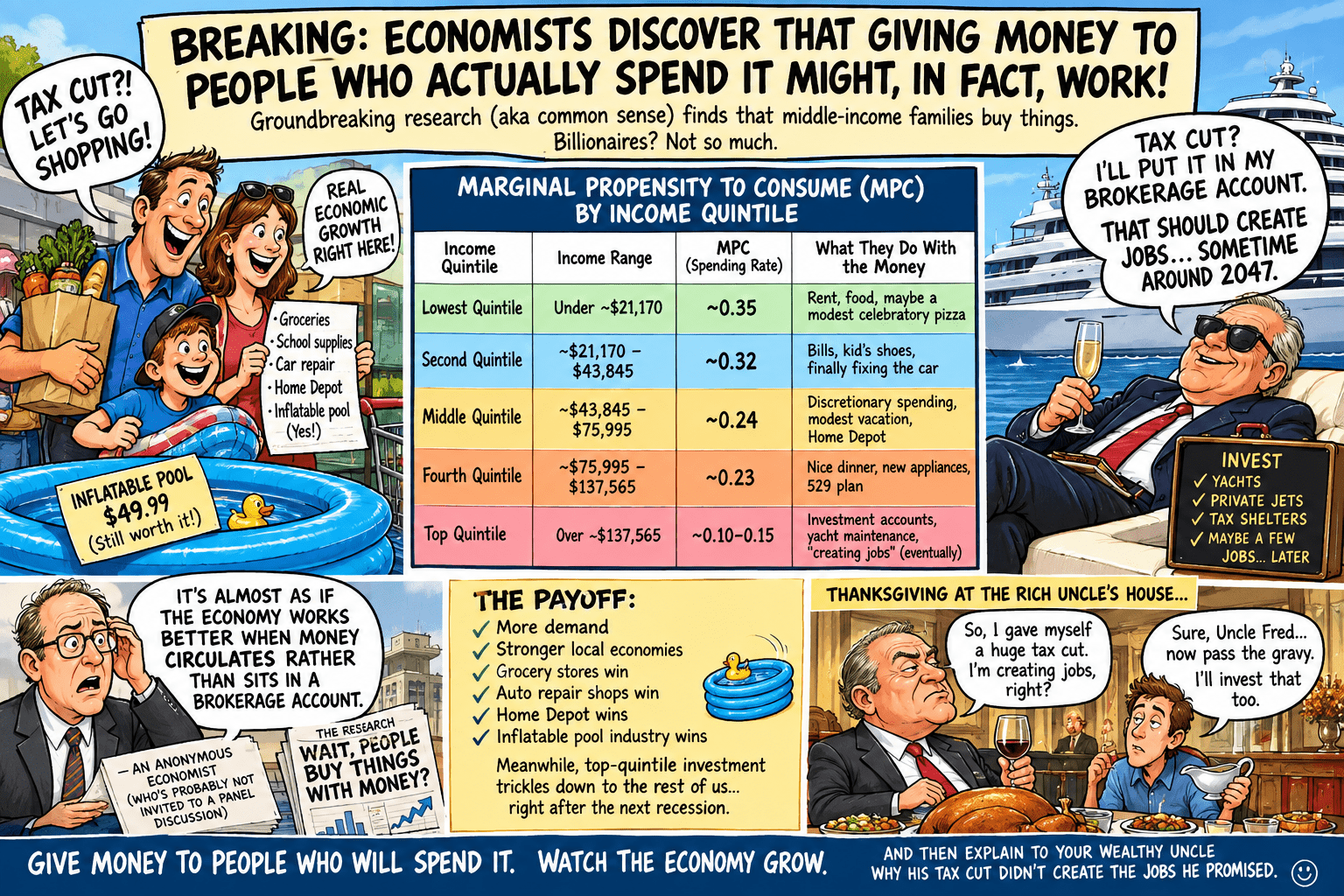
The chart below illustrates the shocking disparity in spending behavior across income groups:
Marginal Propensity to Consume (MPC) by Income Quintile
| Income Quintile | Income Range | MPC (Spending Rate) | What They Do With the Money |
|---|---|---|---|
| Lowest Quintile | Under ~$21,170 | ~0.35 | Rent, food, maybe a modest celebratory pizza |
| Second Quintile | ~$21,170 – $43,845 | ~0.32 | Bills, kid's shoes, finally fixing the car |
| Middle Quintile | ~$43,845 – $75,995 | ~0.24 | Discretionary spending, modest vacation, Home Depot |
| Fourth Quintile | ~$75,995 – $137,565 | ~0.23 | Nice dinner, new appliances, 529 plan |
| Top Quintile | Over ~$137,565 | ~0.10–0.15 | Investment accounts, yacht maintenance, "creating jobs" (eventually) |
The data reveals a tragic pattern: the people most likely to spend money are the ones who need it most, while the people least likely to spend it are the ones who get the biggest cuts. "It's almost as if the economy works better when money circulates rather than sits in a brokerage account," said one economist, who asked to remain anonymous for fear of being invited to a panel discussion.
The practical implications are staggering. If the second, third, and fourth quintiles spent their tax cuts as expected, the resulting demand boost would ripple through local economies—grocery stores, auto repair shops, and the aforementioned inflatable pool industry would all see gains. Meanwhile, top-quintile investment would slowly trickle down to the rest of us, presumably arriving sometime around 2047, right after the next recession. In conclusion, the economic plan is simple: give money to people who will spend it, watch the economy grow, and then explain to your wealthy uncle at Thanksgiving why his tax cut didn't create the jobs he promised—right before he asks you to pass the gravy, which he will then invest rather than consume. ☕ Support The Decline Blog